
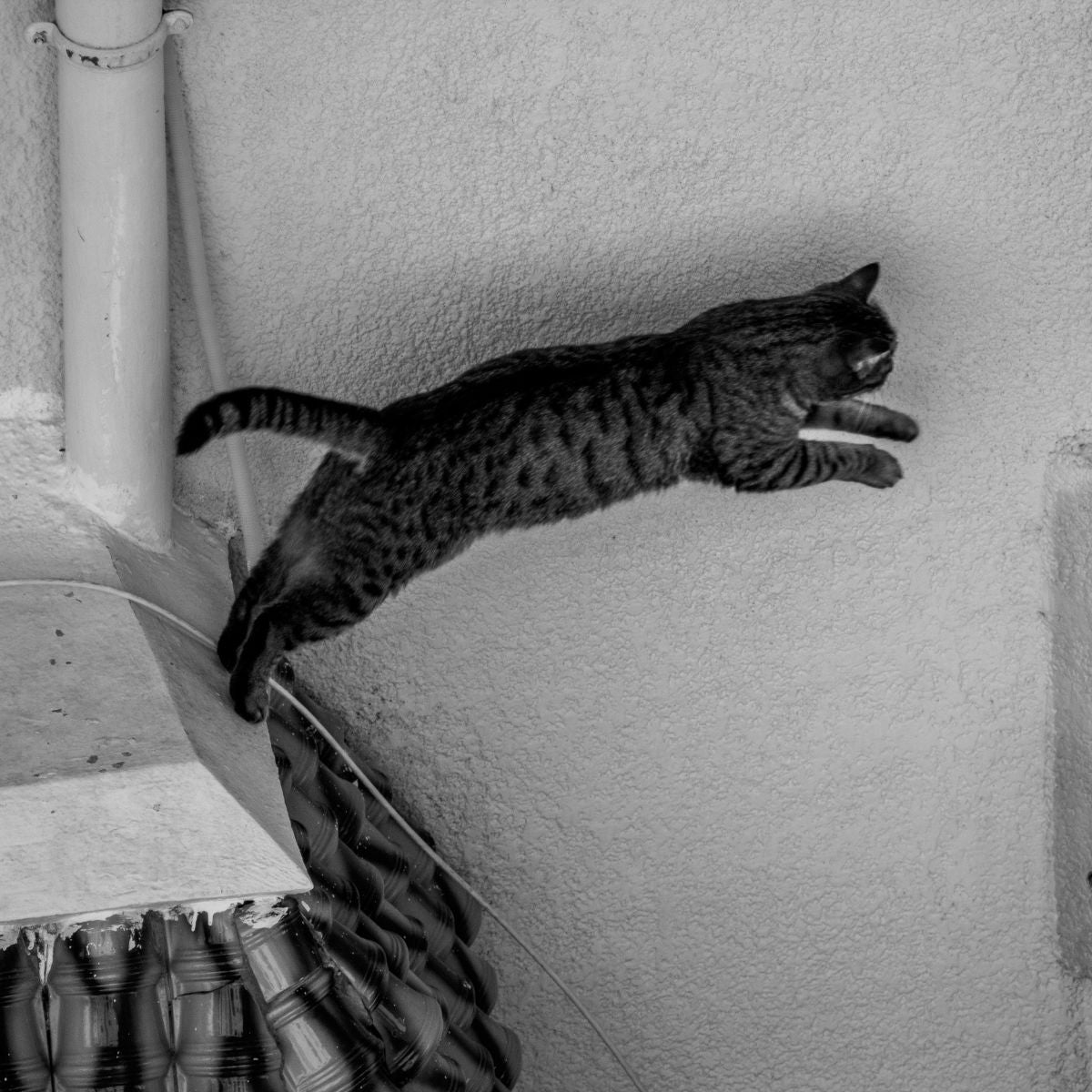
A windowsill, a passing bird, a slightly over-enthusiastic movement… Even with their incredible agility, cats can lose their balance and fall from a window, balcony, or terrace. This is often referred to as high-rise syndrome.
If your cat has just fallen, your first instinct should be to contact a veterinarian, even if they seem fine. And to prevent the accident from happening, a few simple modifications can allow you to keep opening windows or enjoying a balcony while creating a safer environment for your cat.
Table of Contents
- What is high-rise syndrome?
- Why can a cat fall from a window or balcony?
- Do cats always land on their feet?
- From what height can a cat fall without getting injured?
- My cat fell from a window or balcony: what should I do?
- What symptoms should I watch for after a cat falls?
- My cat seems fine after falling: should I still see a vet?
- What injuries can a fall cause in cats?
- Why does my cat hide after a fall?
- How can I prevent high-rise syndrome?
What is high-rise syndrome?
High-rise syndrome, also known as high-rise syndrome in veterinary literature, refers to the injuries sustained by a cat after falling from a certain height, usually from a window, balcony, or terrace.
This type of accident is far from being anecdotal. A study published in 2025 in the Journal of Feline Medicine and Surgery analyzed 1,125 cases of cats that fell from heights. Accidents were notably much more frequent during the summer months, when windows and balconies are more often open. PubMed
The cats involved were also quite young: in this study, their average age was 2.3 years. Another veterinary study involving 119 cases found that nearly 60% of the cats involved were less than a year old. PubMed
Why can a cat fall from a window or balcony?
A cat does not need to intend to “jump into the void” to fall.
It can simply:
- chase an insect or a bird
- pounce on something that catches its attention
- slip on a ledge
- lose its balance
- be startled by a noise or movement
- step on an unstable surface
- land awkwardly after a jump
The Frégis Veterinary Hospital lists cats sitting on windowsills, windows that move with a draft, and the chasing of insects and birds among the classic situations leading to falls from heights. See the recommendations of the Frégis Veterinary Hospital
In other words, even a cautious cat can fall. A safety device is not just intended for particularly adventurous cats: it is precisely what helps prevent these rare and unpredictable accidents.
Do cats always land on their feet?
Cats have a righting reflex that allows them to reorient their bodies during a fall and, in many situations, land on their feet. But landing on their feet does not mean they will emerge unscathed from the fall.
The limbs absorb part of the impact, but the force of the impact can cause fractures, chest injuries, head trauma, or internal injuries.
In a veterinary study involving 132 cats that fell from heights, researchers notably observed chest trauma, pulmonary contusions, pneumothorax, limb fractures, and facial trauma. PubMed
The famous “a cat always lands on its feet” should therefore not give a false sense of security.
From what height can a cat fall without getting injured?
There is no height at which a fall can be considered harmless.
The severity depends on many factors:
- the height of the fall
- the surface on which the cat lands
- its position at the moment of impact
- its age and state of health
- the part of the body that absorbs the impact
A fall from a relatively low height can already cause a fracture or serious trauma. Conversely, some cats survive falls from several stories. This obviously does not mean they emerge unscathed: a study involving 119 cats showed that falls from the seventh floor and above were associated with more severe injuries and more chest trauma.
Even on the first or second floor, it is therefore better to protect any opening accessible to the cat.
My cat fell from a window or balcony: what should I do?
A fall should be considered a traumatic event, even when the cat gets up and seems to walk normally.
Find your cat and keep it safe
After a fall, some cats remain near the point of impact. Others, frightened or in pain, immediately go to hide. Look for it quickly in nearby quiet and sheltered places: under a car, in a hedge, behind an outdoor piece of furniture, or in a corner. Approach it gently. A cat that is usually very affectionate may scratch or bite when it is in pain or disoriented.
Handle your cat as little as possible
Avoid making it walk to “check if everything is okay.” In the event of a fracture or back injury, unnecessary handling can be painful. Place it gently in a carrier with the top removed or, if its condition requires it, on a rigid surface that allows you to move it while limiting movement.
VCA veterinarians recommend keeping the cat as still as possible after a fall and moving it carefully to a veterinary facility. Read VCA's veterinary recommendations on falls in cats
Contact a veterinarian quickly
Even if your cat seems fine after falling, contact a veterinarian. Some internal injuries can be difficult to spot immediately. For example, breathing difficulties related to a pneumothorax, pulmonary contusion, or other traumatic injury may appear after the accident.
A fall from a window or balcony therefore warrants a veterinary evaluation.
What symptoms should I watch for after a cat falls?
Some signs are visible immediately, while others may appear in the hours that follow.
Pay particular attention if your cat:
- breathes rapidly or with difficulty
- breathes with its mouth open
- limps or refuses to put down a paw
- struggles to get up or walk
- remains prostrate
- appears particularly weak
- is bleeding
- shows unusual pain
- salivates or seems to have difficulty eating
- has very pale gums
- seems disoriented
- loses consciousness
Breathing difficulties, an inability to walk normally, or severe lethargy require prompt medical attention.
Blue Cross also explicitly classifies a fall from a height as a trauma requiring a call to a veterinarian and reminds that internal injuries may be present even when the cat seems unharmed. Read Blue Cross's veterinary recommendations
My cat seems fine after falling: should I still see a vet?
Yes! This is probably one of the most important points to remember: a cat that walks after a fall is not necessarily unharmed. Some injuries are not immediately visible from the outside. Chest and abdominal trauma are among the complications described after a fall from a height.
Your cat may also hide its pain, move around for a few minutes, and then become much more lethargic afterward.
Therefore, do not rely solely on its behavior in the first few minutes after the accident.
What injuries can a fall cause in cats?
The nature of the injuries varies greatly from one accident to another.
Chest trauma
The chest is one of the particularly important areas to monitor.
Among the injuries described in cats that fall include:
- pulmonary contusions
- pneumothorax, when air accumulates around the lungs
- certain diaphragm injuries
These injuries can cause rapid or difficult breathing.
Fractures
The limbs can absorb a large part of the impact when landing. In the 2004 study involving 119 cats that fell from heights, 46.2% had a fractured limb. Hind limb fractures were more common than front limb fractures. PubMed Other areas can also be affected, notably the pelvis or jaw.
Head and facial trauma
The impact can cause injuries to the face, jaw, or teeth. Sudden difficulty eating, excessive salivation, bleeding from the mouth or nose, or unusual neurological behavior should be reported to the veterinarian.
Internal injuries
Finally, not all injuries are visible. Abdominal injuries, in particular, may accompany trauma from a fall. Veterinary research has shown that cats with high-rise syndrome may also have abdominal abnormalities detectable by ultrasound. This is precisely why a veterinary examination remains important even when the outside of the body appears intact.
Why does my cat hide after a fall?
After a fall, your cat may immediately look for a place to hide. Fear and stress can explain this behavior, but they are not the only possible causes: a cat in pain also tends to isolate itself.
Therefore, do not assume it is simply frightened.
If it hides after a fall, approach it calmly, avoid chasing it abruptly, and contact your veterinarian to explain the situation. Any change in behavior after trauma should always be taken seriously.
How can I prevent high-rise syndrome?
The best way to reduce the risk remains physically preventing access to the void. Keeping all windows closed at all times is not always realistic, especially in summer. Fortunately, there are different solutions depending on the type of opening and the home.
Secure windows
An open window is particularly attractive to a cat: fresh air, smells, insects, and birds quickly make it a preferred observation post.
A frame, grille, or net allows you to keep the opening while creating a physical barrier.
Felikit offers different window protections for cats adapted to different home layouts.
This type of safety measure is particularly useful when the cat has a piece of furniture, a radiator, or a ledge that allows it easy access to the window.
Protect tilt-and-turn windows
Tilt-and-turn windows present a slightly different risk. The cat may try to pass through the V-shaped opening, slip toward the narrowest part, and get stuck.
There are therefore protective grilles specially designed for tilt-and-turn windows, which allow you to block off the spaces accessible to the cat.
Secure a balcony or terrace
On a balcony, the railing alone is not necessarily sufficient protection. The cat can climb on it, pass through the bars, or access an outer ledge. Depending on the layout, a net, frame, or other closing system can create a protective enclosure around the space.
You can find the different solutions for securing a balcony for cats. If you are renting or want to avoid drilling holes, there are also solutions that allow you to secure a balcony or terrace without drilling.
Is a mosquito screen enough to protect a cat?
Not necessarily. A standard mosquito screen is primarily designed to keep insects out. It is not necessarily intended to support the weight of a cat leaning on it, climbing it, or swiping at it with a paw. For a window accessible to the cat, it is therefore better to use a protection whose strength and fastening system are adapted to this use.
“My cat has never tried to jump” : should I still protect the openings?
This is precisely what makes this type of accident difficult to anticipate. Most cats do not spend their days trying to throw themselves off a balcony. A fall can simply happen the day an insect passes in front of it, or it slips, or a noise startles it.
A recent study involving over a thousand cases also shows that falls occur mainly during periods when openings to the outside are more frequently used, notably in summer. Securing a window or balcony therefore allows you to not rely solely on your cat's usual caution.


