
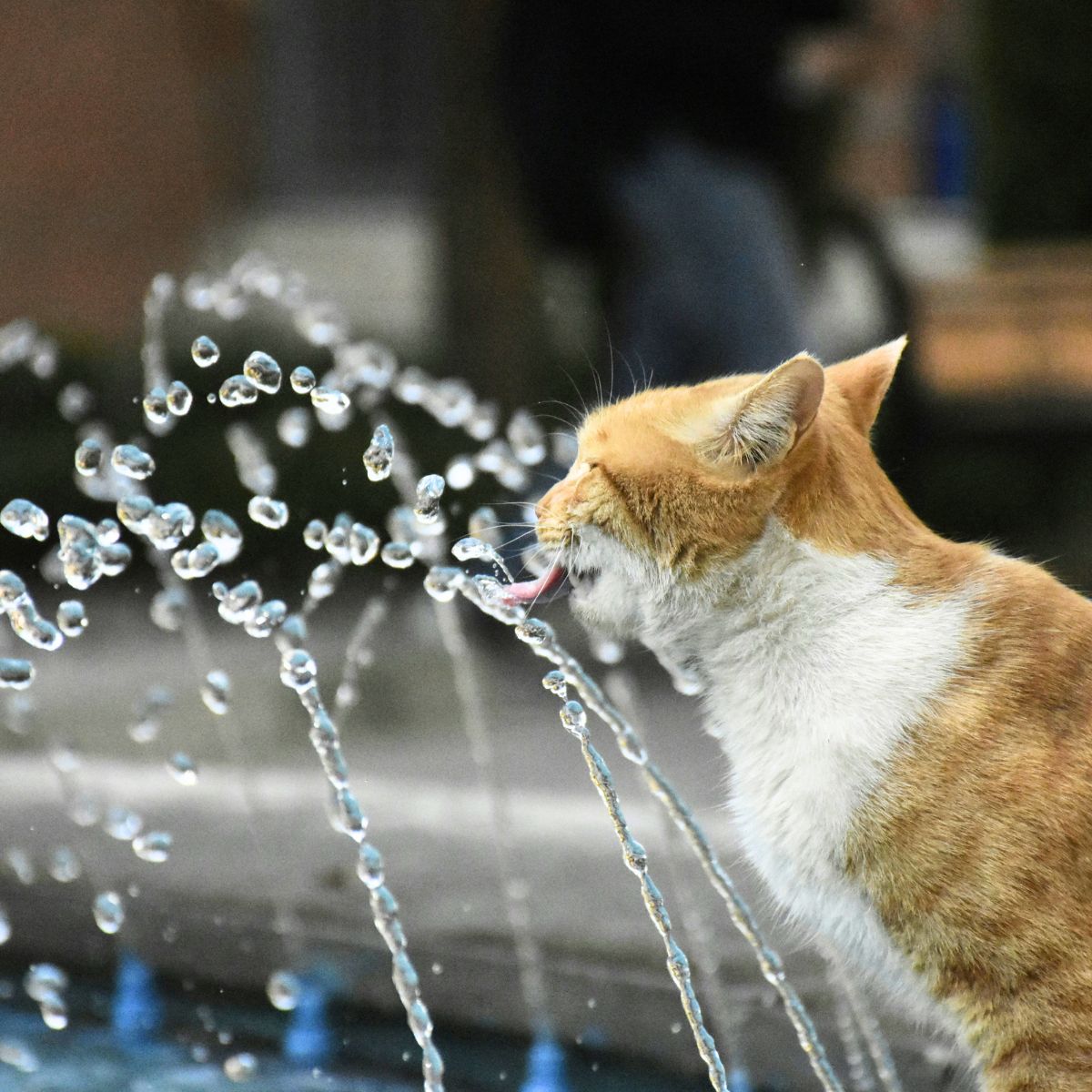
When temperatures rise, our cats naturally adapt their routine: they sleep more, seek out the coolest spots, and slow down their activities. But with heatwaves expected to become more frequent and intense due to climate change, knowing how to help them better cope with the heat is becoming increasingly important for their well-being.
Hydration, keeping the home cool, access to the balcony or garden, signs to watch for: here are the best ways to protect your cat during a heatwave and help them stay comfortable throughout the summer.
Table of Contents
Are cats afraid of the heat?
Cats generally tolerate a moderate rise in temperature quite well. They naturally adapt their behavior: they slow down their activity, seek out the coolest areas, and spend more time resting.
But this ability to adapt has its limits. We saw this clearly in the summer of 2026: videos of indoor cats panting for long minutes because their homes had become too hot circulated widely on social media. However, in cats, panting to cool down is not as common a behavior as it is in dogs: it is often a sign that they are genuinely getting too hot.
During periods of extreme heat, especially when temperatures remain high for several days and homes no longer cool down at night, the body may eventually become unable to release enough heat. In these conditions, finding shade, water, or a cool surface is not always enough: sometimes you need to take active steps to lower the ambient temperature.
And unlike us, cats have few ways to release heat through sweating: this mainly happens through their paw pads. They therefore rely heavily on their environment to maintain a comfortable temperature, seeking shade, cool surfaces, and limiting their exertion. Constant access to cool water is also essential, as noted by the Cornell University Feline Health Center on cat safety in hot weather.
A hot day, around 25 to 30°C, can thus be well tolerated by many cats if they can drink, move to another room, and find a cool place. From 30 to 32°C indoors, especially if there is little air circulation, high humidity, or if the temperature remains high for several hours, vigilance must increase significantly. And when the home approaches or exceeds 35°C, we enter a situation where the risk of overheating becomes much greater, particularly for older, ill, overweight, or flat-faced cats.
During a heatwave, the problem is also one of accumulation: walls, floors, and indoor air remain hot, sometimes even at night, and opportunities for recovery decrease. The VCA Animal Hospitals guide on heatstroke in cats reminds us that cats can also suffer from overheating when their environment no longer allows them to cool down sufficiently.
The main thing, therefore, is to give them real opportunities to adapt: water, shade, cooler areas, and the ability to move away from places that accumulate heat. During the most extreme episodes, these arrangements are no longer just about comfort: they directly contribute to their safety.
How to tell if my cat is hot?
When it is hot, your cat naturally adapts its behavior. It may become calmer, change its resting habits, or seek out new places to settle. These changes are often simply its way of coping better with the temperature.
The important thing is above all to tell the difference between a cat that is adapting normally to the heat and a cat that is beginning to struggle with it.
Normal behaviors when it is hot
During periods of intense heat, your cat may, in particular:
- sleep more
- play less and limit its movement
- seek out tiles or the coolest surfaces
- settle in the shade or in the rooms least exposed to the sun
- stretch out more when sleeping
- drink more often
- eat slightly less
- change its habits to be more active early in the morning or in the evening.
These behaviors allow it to limit its exertion and naturally seek out the areas where it feels best. The Cornell University Feline Health Center recommends, in particular, giving cats constant access to cool water, shade, and cooler spaces during intense heat.
A cat that suddenly spends its days lying on the bathroom tiles is therefore not necessarily in trouble: it has simply found its own little air-conditioned spot.
Signs that your cat is struggling with the heat
Some behaviors, however, should attract more of your attention, especially if your cat:
- pants or breathes with its mouth open
- breathes much faster than usual
- salivates excessively
- appears very weak or particularly listless
- seems disoriented
- has difficulty standing up or walking
- vomits
- has gums that are very red, very pale, or bluish
In cats, marked or persistent panting should not be considered normal behavior simply because it is hot. It may be one of the signs of overheating or heatstroke. VCA Animal Hospitals lists panting, salivation, weakness, and balance problems among the signs that should raise concern.
If your cat has several of these symptoms or if its condition seems to be deteriorating rapidly, place it in a cool place and contact a veterinarian without delay.
Which cats are most sensitive to heatwaves?
All cats can be bothered by intense heat, but some are more vulnerable than others and deserve special attention during heatwaves.
Kittens regulate their temperature even less effectively and can become dehydrated more quickly. Senior cats, meanwhile, may be less mobile, drink less spontaneously, or have chronic illnesses that make it harder for them to adapt to the heat.
Special vigilance is also recommended for:
- cats with heart, respiratory, or kidney disease
- overweight or obese cats
- flat-faced cats, known as brachycephalic cats, such as Persians or Exotic Shorthairs, which may have more breathing difficulties
- cats whose overall health is already weakened
Coat length also deserves some nuance because thick fur can make very hot periods less comfortable, but you should not shave your cat: its coat also helps protect its skin.
Another important piece of information: cats with very light coats, especially those with lightly pigmented ears or noses, are also more sensitive to the effects of the sun. (We don't always think about it, but they can also get sunburned).
If your cat belongs to one of these categories, the goal is simply to offer it more opportunities to regulate its own temperature: several water sources, shaded areas, easy access to the coolest rooms, and slightly more attentive monitoring during heat peaks.
Can you let your cat go outside when it is very hot?
Yes, provided it can always choose between the outdoors and a cooler place. When temperatures rise, the most important thing is not only to secure exits, but also to make sure your cat can easily find shade, water, and a space where the heat remains bearable.
Ideally, outings should be prioritized early in the morning or late in the day, when the sun is less intense.
In a garden
A garden can be pleasant in summer, especially if it offers several natural or created shaded areas. Simply make sure to leave cool water available and, if possible, allow your cat to enter the house freely.
Also think about places that quickly accumulate heat: garden sheds, garages, greenhouses, or small outbuildings can become very hot in a short time. Before closing a door, make it a habit to check that your cat hasn't settled inside for a nap.
During the hottest hours, a ground exposed to direct sunlight can also become uncomfortable. Your cat will generally choose a cooler spot on its own, provided it has several to choose from.
If your cat regularly enjoys the garden, its protection should not be forgotten during the summer either. Nets, suitable fencing, or cat flaps can help secure your garden for your cat with a net or cat flaps while still allowing it to enjoy the outdoors.
In a catio or enclosure
A secure catio for cats or enclosure allows your cat to enjoy the outdoors in a protected space, but you must also think about its thermal comfort.
A space secure against escapes is not automatically secure against heat.
If the enclosure is exposed to the sun for several hours, provide a sufficiently large shaded area, several water sources, and, ideally, access to the indoors. Shade sails, suitable plants, or covered areas can also create more pleasant spaces as the sun moves throughout the day.
Also observe the enclosure's exposure throughout the day: a shaded spot in the morning may be in direct sunlight in the afternoon.
If you are considering setting up this type of space, a secure outdoor enclosure for cats allows you to offer it secure access to the garden. Its location remains essential, however: during a heatwave, your cat must always have a shaded area and be able to reach a cooler place.
And on a balcony or patio during a heatwave?
A balcony can be a wonderful observation post for a cat, but its exposure can change completely throughout the day. A pleasant space in the morning can become very hot a few hours later.
During intense heat, therefore, make sure your cat has a real shaded area, cool water, and, ideally, the ability to enter the house freely. Floors that are very exposed to the sun can also become particularly hot.
The balcony must, of course, be protected against the risk of falls and escapes before allowing your cat access. Depending on its configuration, different balcony protections for cats allow you to secure this space while maintaining its openness to the outdoors.
Once again, safety and coolness go together: a perfectly secure balcony should not become a place where the cat ends up trapped in direct sunlight.
How to protect an indoor cat during a heatwave?
In an apartment, the difficulty often comes from the heat that accumulates throughout the day, especially in homes exposed to the south, under roofs, or equipped with large sliding glass doors.
A few simple steps can help maintain a more comfortable environment:
- close shutters and curtains before the sun heats up the rooms
- air out the home early in the morning and in the evening when the outdoor temperature drops
- allow the cat access to the coolest rooms
- place several water bowls in different locations
- maintain access to tiles and cool surfaces
- promote air circulation when possible
If you want to leave a window open to create a draft, it must remain inaccessible to the cat. A window protection for cats allows you to continue airing the home while limiting the risk of falls or escapes.
Tilt-and-turn windows require extra vigilance: the space created by their opening can be dangerous for a cat trying to squeeze through. A security grille for tilt-and-turn window for cats allows you to specifically secure this type of opening.


